
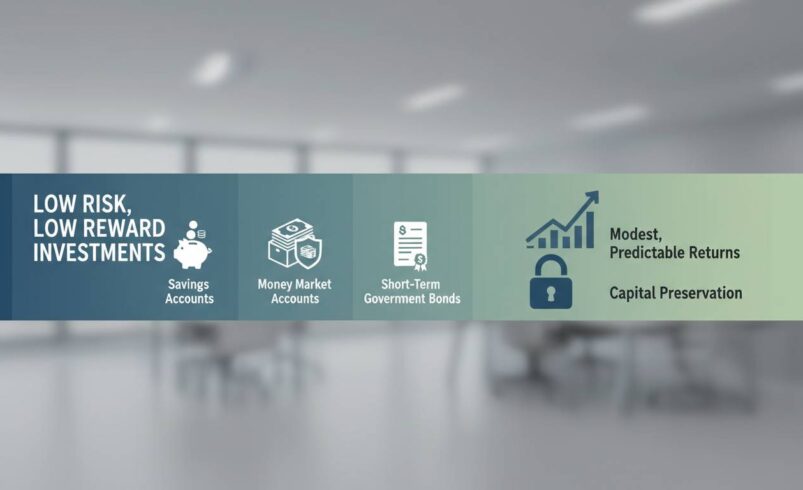

Most investors get the relationship backwards. They focus on what they might gain, treating potential returns as the primary decision driver, while treating risk as an afterthought—a vague sense of unease they hope won’t materialize. This is precisely why most investment literature fails. It asks you to optimize for upside while treating downside as something that happens to other people. The truth is simpler and more uncomfortable: you cannot separate risk from reward. They are the same instrument, different ends of the same spectrum. Understanding this isn’t about learning a formula or memorizing a ratio. It’s about training yourself to see every potential gain as coming packaged with its own potential loss, and learning to make peace with that trade-off rather than searching for an exit that doesn’t exist.
The False Promise of “High Reward, Low Risk”
Walk into any financial conference or scroll through any investing subreddit, and you’ll find someone promising exactly this: returns that defy the basic mathematics of markets. They’re selling something, and you should be skeptical. The efficient market hypothesis, despite its critics, gets one thing fundamentally right: the market prices in available information quickly enough that true “free money” opportunities vanish before individual investors can exploit them.
What most people call “low-risk, high-reward” opportunities usually fall into one of three categories. First, they involve information asymmetry—you know something the market doesn’t, or you’re faster than others. Good luck sustaining that against hedge funds with billion-dollar tech stacks. Second, they’re illiquidity traps—investments that promise attractive returns but trap your capital in ways that make exit difficult or costly. Third, they’re simply mispriced risk where the seller doesn’t understand what they’re giving up. This last category is where individual investors can actually find value, but it requires genuine expertise, not just confidence.
The practical takeaway here isn’t that such opportunities never exist. They’re rare, hard to identify in real-time, and the moment you think you’ve found one, you should interrogate your assumption aggressively. Warren Buffett’s famous dictum—”Never depend on a single income”—applies to your investment thesis too.
Understanding Volatility Versus Permanent Loss
Here’s where most definitions of “risk” in investing fall apart. They treat volatility as risk. And yes, volatility matters for practical purposes: it determines when you might be forced to sell, it affects your psychological ability to hold, it creates the appearance of loss even when none has been realized. But volatility is not the enemy. Permanent loss is the enemy.
A stock that drops 40% and recovers within eighteen months has been volatile. An investor who sold at the bottom has experienced permanent loss. The distinction matters because it changes how you evaluate positions. A high-quality business with strong fundamentals that experiences a market-wide selloff poses different risk than a speculative asset with no underlying cash flows. Both might show similar volatility. Only one deserves your capital when prices fall.
Benjamin Graham understood this distinction clearly. In “The Intelligent Investor,” he made the crucial point that the investor’s primary concern isn’t volatility but permanent impairment of capital. This doesn’t mean you should ignore price movements—it means you should evaluate whether those movements reflect changed fundamentals or merely changed sentiment. The former might justify action. The latter usually justifies patience.
The Risk/Reward Ratio: What It Actually Tells You
When someone asks “what’s your risk/reward ratio,” they’re asking a deceptively simple question. The calculation is straightforward: divide your potential gain by your potential loss. A 1:2 ratio means you risk $1 to potentially make $2. Most trading educators recommend seeking at least 1:2, some recommend 1:3. This sounds reasonable until you try to apply it to real-world investing, where the “potential” parts of that equation are notoriously difficult to estimate.
The problem isn’t mathematical. It’s epistemological—you genuinely don’t know what the upside or downside will be for most investments. You’re making probabilistic estimates based on incomplete information, and the confidence interval on those estimates is enormous. A 1:2 ratio on a position where your probability estimates are imprecise gives you a false sense of precision about an inherently uncertain outcome.
What the ratio actually tells you, then, is less about the trade and more about your own assumptions. If you’re taking a position with a 1:1 ratio, ask yourself why you’re accepting equal risk for potentially unequal reward. If you’re requiring 1:3, ask whether you’re being realistic about that upside target or whether you’re just setting yourself up to pass on good opportunities that don’t meet an arbitrary threshold.
Why Your Risk Tolerance Isn’t What You Think It Is
Here’s an uncomfortable truth: most investors don’t know their actual risk tolerance. They know their hypothetical risk tolerance—the answer they’d give in a questionnaire if someone asked how they’d feel about a 20% portfolio decline. But hypothetical tolerance and actual tolerance are different creatures, separated by the gulf between imagination and experience.
I worked with an investor once who insisted, in calm office conversation, that he could handle a 30% drawdown without panic. He’d done the math. He understood that such declines happened periodically and that recoveries were inevitable. Six months into the 2020 pandemic, when his portfolio was down roughly that much in a matter of weeks, he called in a panic wanting to sell everything and move to cash. His hypothetical tolerance had no relationship to his actual behavior under stress.
The fix isn’t to find the “right” risk tolerance number. It’s to build systems that account for the gap between your imagined self and your actual self. This means position sizing conservatively enough that you won’t panic when markets move against you. It means holding enough cash or low-volatility assets that you can sleep at night. It means understanding that your capacity to endure loss is probably lower than your intellectual assessment suggests—not because you’re weak, but because human psychology is wired for loss aversion in ways that questionnaires don’t capture.
The Tyranny of Average Returns
Average returns are a statistical fiction that no investor actually experiences. Your returns arrive in lumps—years of gains, years of losses, occasional boom periods, occasional bust periods. A portfolio that returns 8% on average might deliver 40% in one year, -15% in another, 12% in a third. The average describes none of those years accurately.
This matters for risk planning because the sequence of returns determines your outcome as much as the average return itself. If you withdraw during a down period early in retirement, you’re at severe risk of portfolio failure even if long-term averages look fine. If you accumulate during a prolonged bull market, your portfolio might feel safer than it actually is because you’ve never experienced the stress test of a serious decline.
The solution isn’t to try predicting which sequence you’ll get—you can’t. It’s to build a portfolio whose worst-case scenario across a reasonable time horizon still allows you to meet your goals. This means stress-testing your portfolio against historical bad periods, not just assuming the future will look like the recent past. It means understanding that “average” conditions don’t exist and designing for the range of possibilities, not the center of the distribution.
Why Diversification Fails When You Need It Most
Diversification is the closest thing to a free lunch in investing. It reduces portfolio volatility without necessarily reducing expected returns. But it’s not magic, and it has limits that most investors don’t appreciate until crisis reveals them.
During the 2008 financial crisis, diversification failed spectacularly for many portfolios. Stocks fell. Bonds fell. Real estate fell. Commodities fell. The correlations that were supposed to provide protection all went to one at precisely the wrong moment. This wasn’t a failure of diversification theory—it was a reminder that diversification protects against specific risks, not against all risks simultaneously. When the systemic crisis hits, the life rafts are all tethered to the same sinking ship.
The practical implication isn’t to abandon diversification. It’s to understand what your diversification is actually protecting against. Asset class diversification protects against single-asset failures. Geographic diversification protects against country-specific crises. Temporal diversification (spreading investments over time) protects against timing risk. Each addresses a different threat. A portfolio diversified only by asset class might feel diversified but could still be vulnerable to the one risk that matters most in a given moment.
The Narrative Fallacy: Why Stories About Risk Are Dangerous
Humans are pattern-seeking creatures. We can’t help it. We see stories where there are only numbers, causation where there is only correlation, meaning where there is only noise. In investing, this trait is particularly dangerous because the market is so full of post-hoc explanations that make past movements seem predictable.
After every market crash, you’ll find analysts who “saw it coming.” They’ll point to specific signals that, in retrospect, clearly indicated trouble. What they won’t show you is all the times they saw crashes that didn’t happen, all the signals that flashed warning without subsequent decline. The narrative of the past is easy to construct. The prediction of the future remains impossible.
This matters for risk assessment because we tend to weight recent vivid stories far more heavily than statistical base rates. An investor who watched their neighbor lose everything in Enron might become convinced that individual stock ownership is unbearably risky, even though the statistics don’t support that conclusion. An investor who experienced the 2009 recovery might become convinced that buying during panic is always rewarded, even though that outcome wasn’t guaranteed.
The discipline here is to distinguish between a good story and a good investment. Ask whether the thesis survives translation into numbers. Ask what would have to be true for your narrative to work, and whether you’ve actually estimated those probabilities rather than just feeling confident in the story.
Position Sizing: The Only Risk Control That Truly Matters
If there’s one idea from this article that you remember six months from now, make it this: position sizing is the primary determinant of your investment outcomes, more important than which specific securities you own or when you buy them. This isn’t intuitive—most investors spend enormous energy on security selection and almost none on how much of each to buy.
The logic is straightforward. A 5% position that goes to zero loses you 5% of your portfolio. A 40% position that goes to zero loses you 40%. Your ability to be right about the big position has to be substantially higher than your ability to be right about the small one, because the cost of being wrong scales linearly with position size. Most investors do the opposite: they size positions based on conviction, putting more money where they feel more confident, without adjusting for the magnitude of potential loss if confidence proves misplaced.
The practical framework is to size positions inversely to your confidence and directly to the severity of downside. Your highest-conviction ideas should probably still be your smallest positions, because high conviction usually correlates with high certainty, and high certainty about complex things is usually hubris. Your largest positions should be boring, diversified, low-conviction bets—index funds, broadly allocated holdings where you’re not claiming to know more than the market.
The Role of Time: Why Time Heals (Most) Investment Wounds
Time is the investor’s greatest ally, but only if the wounds are healable. A portfolio invested in a diversified mix of sound businesses, bought at reasonable prices, will almost certainly recover from any market decline given enough time. A portfolio invested in a fraud, or in a dying industry, or leveraged beyond its capacity to absorb losses, will not recover regardless of how patient you are.
This distinction matters enormously for risk assessment. When someone says “time heals all wounds” in investing, they’re making a claim that needs qualification. Time heals wounds that are about price but not about fundamental impairment. Time makes a temporary discount into a permanent gain. Time does not turn a bad business into a good one, a leveraged balance sheet into a stable one, a fraudulent scheme into a legitimate enterprise.
The practical question for any investment isn’t whether it will recover, but whether it’s capable of recovering. This requires understanding the underlying asset, not just its price history. A broad stock index has recovered from every market crash in history. An individual company might not. Don’t confuse the track record of the aggregate with the prospects of the specific.
Making Peace With Uncertainty
Here’s the honest admission that most investment articles avoid: you cannot precisely quantify risk, no matter how sophisticated your models become. You can estimate it. You can bound it. You can build margins of safety that make extreme outcomes survivable. But you cannot measure it with the precision that the numbers suggest.
This isn’t a failure of finance as a discipline. It’s a feature of complex systems. Markets are emergent phenomena arising from millions of individual decisions, each influenced by information, emotion, and randomness in ways that resist precise prediction. The future is genuinely uncertain in ways that historical data can only partially illuminate.
What this means for you is that the goal isn’t to eliminate risk—it’s to take risks you understand and can survive. Build portfolios that acknowledge uncertainty rather than pretending it doesn’t exist. Size positions so that being wrong doesn’t break you. Hold assets that have fundamental value independent of market sentiment. And accept that you’ll never have perfect information about what comes next.
The investors who do best over long periods aren’t the ones who avoid risk—they’re the ones who take calculated risks, build in buffers for being wrong, and stay in the game long enough for probability to work in their favor. That’s the actual game. Not maximizing returns, but maximizing the probability of reaching your goals while sleeping at night.
Risk and reward aren’t opponents to be balanced. They’re dance partners to be understood. Learn the steps, watch your partner, and don’t try to lead everything.