
Index funds have changed how everyday people build wealth. Most actively managed funds cannot beat the market over time — that’s just the reality. Instead of trying to outsmart thousands of other investors with better information and faster computers, index funds simply own everything in a given market and let you ride along with its growth. The math favors you. This guide walks you through how to put your money to work in index funds, from opening your first account to making your initial purchase.
What Are Index Funds and Why Should You Invest in Them?
An index fund is a type of investment fund that holds securities designed to track a specific market index. When you buy shares of an S&P 500 index fund, you’re owning tiny slices of the 500 largest publicly traded companies in the United States — Apple, Microsoft, Amazon, Nvidia, and hundreds of others — all in a single purchase.
This matters because picking winning stocks is incredibly hard. Dalbar, a financial research firm, has studied investor behavior for decades. Their research consistently shows that the average equity fund investor underperforms the broader market by a significant margin — often 3 to 5% annually — not because the funds are bad, but because investors buy and sell at the wrong times. Index funds eliminate that timing risk entirely.
The fees matter too. Actively managed mutual funds frequently charge expense ratios of 0.75% to 1.5% or higher. Compare that to Vanguard’s S&P 500 ETF (VOO), which charges just 0.03% annually. Over a 30-year retirement savings horizon, those fee differences can cost you hundreds of thousands of dollars on a moderate portfolio.
Index funds provide diversification automatically. Buying one share of a total stock market fund gives you exposure to thousands of companies across every major sector. If Apple has a bad quarter but Nvidia has a great one, they cancel out — your portfolio reflects the overall health of the economy rather than the fortunes of any single company.
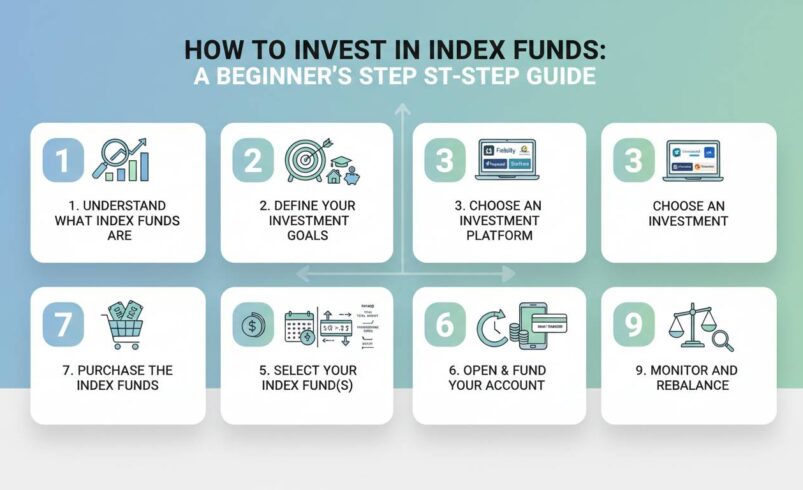
Step 1: Choose the Right Brokerage Account
Before you can buy anything, you need a place to hold your investments. This means opening a brokerage account with a firm that gives you access to index funds at reasonable prices.
For most beginners, the choice comes down to a few key factors: whether the broker charges commissions on fund trades, whether there are account minimums, and what index funds are actually available to purchase.
Fidelity, Charles Schwab, and Vanguard all offer commission-free trading on a wide selection of index funds. All three have no minimum deposit requirements for standard brokerage accounts, meaning you could open an account today and fund it with $1. Vanguard has a particular advantage if you plan to buy their proprietary funds — they created the index fund category and their offerings are extensive. Schwab offers access to both their own index funds and third-party options. Fidelity provides strong research tools and has recently expanded its zero-expense-ratio fund lineup.
If you’re investing through a tax-advantaged retirement account, check whether your employer offers a 401(k) with low-cost index fund options. Many do now, and getting employer matching contributions is essentially free money that beats any investment return you could earn elsewhere.
Avoid brokers that charge per-trade commissions or impose high account minimums. The fee structure has become so competitive that there’s no reason to pay for access to index funds anymore.
Step 2: Select Your Index Funds
Now comes the actual decision: which index funds should you own? The answer depends on your goals, timeline, and comfort with market swings.
For most beginners, a total stock market index fund serves as an excellent core holding. Vanguard Total Stock Market ETF (VTI) tracks the entire US stock market — roughly 4,000 companies of various sizes. This gives you maximum diversification across sectors and company sizes in one simple investment.
If you want something narrower, an S&P 500 index fund tracks the 500 largest US companies. This is what most people mean when they talk about “the market.” Popular options include Vanguard S&P 500 ETF (VOO), iShares Core S&P 500 ETF (IVV), and SPDR S&P 500 ETF (SPY). All three track the same index and perform nearly identically over time — the minor differences in expense ratios (ranging from 0.03% to 0.09%) will make microscopic differences in returns over decades.
International exposure matters too. A common portfolio strategy holds about 80-90% US stocks and 10-20% international stocks. Vanguard Total International Stock ETF (VXUS) provides this exposure across developed and emerging markets. Some investors prefer to keep it simple with a single US fund; others want the global diversification. Either approach works if you stick with it.
Bond index funds provide stability and income if you’re closer to retirement or simply want less volatility. Vanguard Total Bond Market ETF (BND) is a popular choice that holds thousands of US government and corporate bonds.
The specific funds matter less than actually buying something and staying invested. Don’t paralyze yourself searching for the perfect fund. Pick a reputable total market fund, put money in consistently, and move on to the next step.
Step 3: Determine Your Investment Amount
One of the best things about index fund investing is that there’s no minimum investment beyond the price of a single share. For VTI, that means you can start with under $250. Many brokers even allow you to buy fractional shares, meaning you could invest $50 or $100 if that’s what your budget allows.
The real question isn’t how much you need to start — it’s how much you can consistently contribute. This is where dollar-cost averaging becomes powerful. Instead of trying to time the market by waiting for the “right moment,” you invest a fixed dollar amount at regular intervals — say $500 every month, or $200 every two weeks. When markets are up, your fixed dollars buy fewer shares. When markets are down, your dollars buy more shares. Over time, this smooths out the volatility and typically produces solid returns without the stress of guessing where prices are heading.
If you’re investing inside a Roth IRA, you can contribute up to $7,000 annually as of 2024 (or $8,000 if you’re 50 or older). Traditional IRAs have the same limits. 401(k) limits are higher — $23,000 for 2024, with employer match on top.
A practical starting point: contribute enough to your employer’s 401(k) to get the full match, then max out a Roth IRA if you qualify, then return to the 401(k) if you have additional money to invest. This sequence optimizes for tax advantages while ensuring you don’t leave free money on the table.
Step 4: Execute Your First Purchase
With your account funded and your funds selected, it’s time to actually buy. The process is straightforward, but it helps to walk through it once.
Log into your brokerage account and navigate to the trade or buy screen. Search for your chosen fund using its ticker symbol — VTI, VOO, VXUS, or whatever you’ve decided on. Enter the dollar amount you want to invest (or the number of shares, if you prefer). Review the order details: make sure you’re buying the right fund, at the right price, in the right account.
For most brokerages, a “market order” executes immediately at the current price and is the appropriate choice for simple index fund purchases. “Limit orders” let you specify a maximum price, which makes sense if you’re buying during market hours and want more control, but for a beginner building a long-term position, market orders are perfectly fine.
After executing your purchase, confirm that the shares appear in your account. Then step back. You’re now a shareholder in hundreds of companies. Congratulations.
One important decision: taxable brokerage account or tax-advantaged account? If this is money you’re saving for retirement decades away, a Roth IRA or traditional IRA typically makes more sense than a standard brokerage account because your investments grow tax-free or tax-deferred. If you’re saving for something more near-term — a house down payment in five years, for example — a taxable account gives you more flexibility to access the money without penalty.
Step 5: Build and Manage Your Portfolio Over Time
Buying your first index fund is the hardest part psychologically. Everything after that is maintenance.
The most important habit is consistency. Set up automatic contributions from your bank account to your brokerage on payday. Treat it like a bill that goes to your future self. People who do this consistently — regardless of whether markets are rising or falling — tend to build substantial wealth over time.
Rebalancing becomes relevant as your portfolio grows. Suppose you start with 100% stocks. Over several years, if stocks perform well, you might find yourself with 90% stocks and 10% bonds when your target allocation was 80/20. Rebalancing simply means selling the overweighted asset class and buying the underweighted one to return to your target. This forces you to “buy low, sell high” automatically. Many brokerages offer automatic rebalancing services, or you can do it manually once or twice a year.
Don’t check your account constantly. Daily fluctuations are noise. Monthly reviews are reasonable. Annual check-ins are sufficient for most long-term investors. The more you stare at your balance, the more likely you are to make emotional decisions that hurt your returns.
One mistake to avoid: chasing performance. If a particular index fund has a great year, resist the urge to pour money into it. By the time a strategy outperforms, much of the advantage has already been captured. Stick to your plan. Low-cost, diversified index funds have earned their place in your portfolio through decades of evidence — don’t abandon them because something newer and flashier appears.
Frequently Asked Questions About Index Funds
What is the best index fund for beginners?
A total stock market index fund like VTI or a broad S&P 500 fund like VOO serves most beginners well. Both provide instant diversification, have extremely low fees, and require no ongoing management decisions. You can’t go wrong with either as a core holding. As you learn more, you might add international stocks, bonds, or other asset classes — but you don’t need complexity to start.
How much money do I need to start investing in index funds?
You can start with as little as the price of one share. VTI trades around $250 as of early 2025, VOO around $500. Many brokers now offer fractional shares, so you could theoretically start with $10 or $25 if that’s what your budget allows. The amount matters far less than starting at all.
Are index funds safe?
All investments carry risk — index funds are not immune to market downturns. When the stock market falls 30%, your index fund will fall roughly 30% too. However, the historical pattern is clear: markets recover and reach new highs over time. The broader the index, the more stable the ride tends to be. Bond index funds are less volatile but offer lower long-term returns. Safety depends entirely on your time horizon and risk tolerance.
What’s the difference between index funds and ETFs?
An ETF (exchange-traded fund) is a structure — it trades like a stock on an exchange. An index fund can be structured as either a mutual fund or an ETF. VOO and VTI are ETFs that track indexes. Vanguard also offers mutual fund versions (VTSAX, VFIAX) that work similarly but trade differently. For most investors, the distinction doesn’t matter much — both are excellent low-cost ways to own index funds.
Can I lose money in index funds?
Yes. Any investment in the stock market can lose value in the short term. Index funds that hold stocks will decline during bear markets. The key insight is that long-term investors who stay the course historically have been rewarded — the S&P 500 has returned roughly 10% annually over very long periods despite numerous crashes, recessions, and crises along the way.
Conclusion
Index funds represent one of the most powerful wealth-building tools available to ordinary investors. They offer diversification that would be impossible to achieve on your own, fees low enough that they won’t erode your returns over decades, and simplicity that frees you from the stress of trying to predict which stocks will win.
The hardest part is starting. Open that brokerage account. Make your first purchase. Set up automatic contributions and let time do the work. You don’t need to be a finance expert, and you don’t need a fortune. You need consistency, patience, and the willingness to ignore the noise.
The evidence is unambiguous: index funds have outperformed the vast majority of actively managed money over every meaningful time horizon. The market rewards patience, not cleverness. Start today.