

Most investors never actually calculate their risk tolerance—they just guess. Then they either panic sell when markets drop or take on more volatility than they can sleep at night with. Neither outcome is inevitable. Understanding your true risk tolerance isn’t a vague exercise in self-reflection; it’s a concrete framework that directly determines whether you’ll stick to your investment strategy when it matters most. This guide breaks down exactly what risk tolerance means, why it differs from risk capacity, and provides a practical self-assessment you can use today to align your portfolio with who you actually are as an investor—not who you hope to be.
Understanding risk tolerance in investing
Risk tolerance refers to the degree of variability in investment returns that an investor is willing and able to withstand. More simply: it’s how much market turbulence you can emotionally and financially handle without making destructive decisions. If your portfolio drops 20% in a month and you sell everything in a panic, your risk tolerance was lower than your portfolio assumed. If you barely notice the fluctuation and stay the course, you have higher risk tolerance.
This isn’t about being brave or disciplined. It’s about honest self-assessment. Your risk tolerance is shaped by your financial situation, your time horizon, your emotional makeup, and frankly, your life experience. Someone who lost money in the 2008 financial crisis has a very different relationship with market volatility than someone who started investing in 2020 during the recovery.
The critical misunderstanding most people carry is that risk tolerance is fixed. It isn’t. Your risk tolerance at 25 differs from your risk tolerance at 45, and it should differ again at 65. The goal isn’t to find your “permanent” risk tolerance—it’s to understand it well enough to build a portfolio you can actually maintain through market cycles.
Risk tolerance vs risk capacity: The distinction most people miss
Here’s where the conversation gets interesting, and where most generic financial articles fail. Risk tolerance and risk capacity sound similar, but they measure completely different things—and confusing them is the single biggest mistake DIY investors make.
Risk tolerance is psychological. It’s about how you feel about risk. Can you watch your account balance swing up and down without anxiety? Do market crashes keep you up at night? These are emotional responses that vary wildly between individuals, even with identical financial situations.
Risk capacity, on the other hand, is purely mathematical. It’s about your actual ability to absorb losses without it derailing your life goals. A 25-year-old with a stable income, no debt, and 40 years until retirement has enormous risk capacity—even if they have low risk tolerance. A 60-year-old living on fixed income with no additional earning potential has low risk capacity, regardless of how emotionally comfortable they are with volatility.
The portfolios of these two people should look completely different, and the difference isn’t just about how they feel. It’s about what they can actually afford to lose. I’ve seen investors with high risk tolerance but low risk capacity take on unnecessary risk because they confused comfort with capability. Conversely, I’ve watched financially secure investors with high capacity play far too conservatively because they let short-term anxiety dictate decisions that should be based on long-term math.
The right question isn’t just “how much risk can I handle?” It’s “how much risk should I take given my actual financial situation, and how much can I emotionally tolerate?” The intersection of these two factors is where your optimal portfolio lives.
How to assess your risk tolerance
The most honest assessment starts with brutal self-examination, not a questionnaire. Before you answer a single quiz question, spend 10 minutes with a simple thought experiment: imagine your portfolio lost 40% of its value in three months. Not “gained or lost”—specifically lost. What would you actually do? Would you sell everything, move to cash, and swear off stocks forever? Would you buy more? Would you do nothing? Your answer reveals far more about your true risk tolerance than any standardized questionnaire.
That’s the emotional component. But for a structured assessment that accounts for both sides of the risk equation, work through these questions honestly. Score yourself on a 1-5 scale where 1 is the most conservative and 5 is the most aggressive.
-
When you invest money, what’s your primary expectation? Preserve my money above all (1-2) / Grow my money significantly (4-5)
-
If you had to choose between guaranteed 2% returns or a 50% chance at 12% returns with a 50% chance of losing money, which do you take? (1-5)
-
How long will this money need to grow before you withdraw it? Less than 3 years (1) / 3-7 years (2-3) / 7-15 years (4) / 15+ years (5)
-
What would you do if the market crashed 30% tomorrow? Sell everything (1-2) / Do nothing (3) / Buy more (4-5)
-
How would you describe your knowledge of financial markets? Minimal (1-2) / Moderate (3) / Extensive (4-5)
-
What’s your current income situation? Unstable or uncertain (1) / Stable but modest (2-3) / Stable and comfortable (4-5)
-
Do you have emergency savings equal to 3-6 months of expenses? No (1) / Yes (4-5)
-
What’s your age range? 50+ (1-2) / 35-49 (3) / Under 35 (4-5)
-
How much would a 50% portfolio loss impact your overall financial health? Critically (1) / Significantly (2-3) / Minimally (4-5)
-
What investment outcomes have you personally experienced? Significant losses (1-2) / Mostly gains but with dips (3-4) / Consistent gains (5)
Add up your score. Here’s what the ranges actually mean in practice:
10-20 points: You have genuinely low risk tolerance, and that’s okay. Your portfolio should reflect this. Fighting your natural instincts creates behavior risk that often costs more than the returns you might gain from taking more risk.
21-35 points: You fall in the middle ground—capable of handling some volatility but not all. A balanced or moderately conservative approach aligns with your actual psychology.
36-50 points: You either have high risk tolerance or you’re answering the questions based on how you want to see yourself rather than how you actually behave. Be honest in your self-reflection. The score only matters if it’s accurate.
Factors that influence your risk tolerance
Your questionnaire score doesn’t exist in a vacuum. Several concrete factors shape where you fall on the risk spectrum, and understanding them helps explain why your tolerance might differ from someone else in seemingly similar circumstances.
Income stability dramatically affects both capacity and tolerance. A freelancer with variable income naturally develops lower risk tolerance because they’ve experienced periods without pay. A tenured government employee with a guaranteed pension has a different psychological relationship with risk because their income doesn’t fluctuate. Same net worth, completely different risk profiles.
Life stage matters more than most advisors acknowledge. A 30-year-old with a newborn has different obligations than a 30-year-old without children, even with identical salaries. Your risk tolerance should shift when your responsibilities change, not just when your age changes.
Prior investment experience shapes risk tolerance in ways that aren’t always rational. Someone who invested through the 2008 crash and stayed the course often develops higher risk tolerance—not because they enjoyed the experience, but because they survived it and learned they could handle it. Someone who started investing at the top of the market in 2021 and experienced their first significant downturn may have artificially low risk tolerance because they’ve only seen one side of the cycle.
Net worth composition influences how much stock market volatility actually affects you. If most of your net worth is already in real estate and cash, a volatile portfolio represents a smaller portion of your total wealth—and your risk tolerance for that portion can be higher. If your investment portfolio is your primary asset, you’re right to be more conservative with it.
The counterintuitive truth: your risk tolerance should decrease as you accumulate more wealth, not because you have less ability to absorb losses, but because you have more to protect. A $100,000 portfolio losing 20% is $20,000. A $1 million portfolio losing 20% is $200,000. Same percentage, vastly different psychological impact.
Your risk profile categories
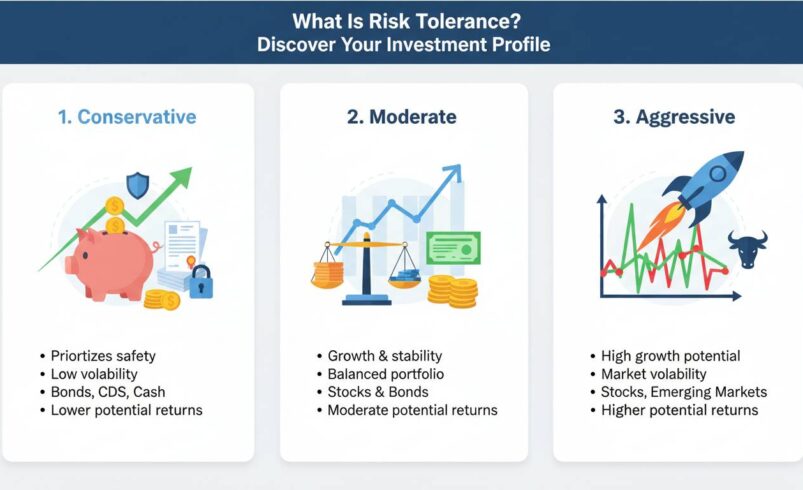
Understanding where you fall on the risk spectrum requires clear categories. Most financial institutions use five standard profiles, ranging from conservative to aggressive. Here’s what each actually looks like in practice—not in theory, but in how people with these profiles actually behave when markets move.
Conservative investor
Conservative investors prioritize capital preservation over growth. They’re willing to accept lower returns to avoid the emotional pain of losses. In practice, this means portfolios heavy on bonds, cash equivalents, and dividend-paying stocks with long track records. The trade-off is clear: inflation erodes purchasing power over time, but the sleep-at-night factor is high.
A conservative investor in 2022 watched the S&P 500 drop nearly 20% and felt nothing but relief that their portfolio was mostly in bonds and cash. They didn’t participate in the 2023 recovery fully, but they also didn’t panic sell. This isn’t a failure of strategy—it’s a valid choice that matches their psychology.
Moderately conservative investor
This profile accepts some downside in exchange for modest growth. A typical allocation might be 30-40% stocks, 60-70% bonds and cash. The goal is to beat inflation while maintaining a margin of safety.
Moderately conservative investors get uncomfortable when markets drop significantly, but they can talk themselves through it. They tend to check their accounts less frequently and respond better to reminders about long-term performance. They’re not trying to get rich—they’re trying to not run out of money while earning something beyond cash returns.
Moderate investor
The moderate investor accepts roughly equal chances of gains and losses in exchange for moderate growth potential. A 50/50 or 60/40 stock/bond allocation fits this profile. This is the most common “default” recommendation, and honestly, it’s where a lot of people land without much thought.
Here’s the uncomfortable truth: moderate investors need to be able to handle significant volatility. A 50/50 portfolio lost about 25-30% in 2008-2009. That’s not a theoretical number—that’s what actually happened. If you claim to be a moderate investor but sold in 2008, you were actually a conservative investor who hadn’t admitted it to yourself yet.
Moderately aggressive investor
These investors want meaningful growth and are willing to accept substantial short-term volatility to get it. Allocations of 70-80% stocks are common, with the remaining in bonds for some stability.
Moderately aggressive investors understand that market drops are temporary and recoveries happen. They tend to view volatility as opportunity rather than threat. They also tend to be younger, with longer time horizons, or older but with substantial wealth that allows them to take risks with a smaller portion of their total assets.
Aggressive investor
Aggressive investors maximize growth potential. Portfolios are 80-100% stocks, often including small-cap stocks, international markets, and sectors with higher volatility. They accept that they might lose half their money in a severe downturn—and they have the time, income, or wealth to wait for recovery.
This profile only works for people with genuine long time horizons (20+ years), stable income or wealth outside their portfolio, and the emotional discipline to do nothing when everyone else is panicking. If you’re envious of aggressive investors’ returns, remember: they earned those returns by enduring losses you’re not willing to experience.
How to use your risk tolerance in investment decisions
Knowing your risk tolerance is useless if it doesn’t change how you invest. The connection should be immediate and concrete.
Your risk tolerance should directly determine your asset allocation. If the self-assessment showed low risk tolerance, a 90% stock portfolio isn’t appropriate—even if a financial advisor or online calculator recommends it. The best portfolio is the one you can actually stick with. A slightly suboptimal allocation you maintain beats a theoretically optimal allocation you abandon during the first significant downturn.
Rebalancing decisions should account for risk tolerance shifts. If your score changes because your life circumstances changed—a new child, job loss, inheritance, divorce—your portfolio should change too. This doesn’t mean timing the market. It means recognizing that your capacity and tolerance evolve, and your investments should evolve with them.
Avoid the temptation to “set and forget” indefinitely. Check in annually. Major life events warrant immediate reassessment. Your risk tolerance profile isn’t a permanent tattoo—it’s a map that needs updating as you travel.
One practical step: calculate your “stress allocation.” This is the amount of money you could lose entirely—every dollar, gone—and it wouldn’t change your life. Not your rent money. Not your child’s tuition. Not your retirement. That’s the portion of your portfolio that can genuinely afford to take maximum risk. If that number is small, your overall portfolio should reflect appropriate caution.
Frequently asked questions about risk tolerance
Can my risk tolerance change over time?
Absolutely. Risk tolerance is dynamic, not static. It changes with age, income, wealth, life circumstances, and market experience. What felt comfortable at 25 often feels reckless at 45. That’s normal and expected.
Should I take more risk just to get higher returns?
No. That’s the fundamental error. Risk should be taken only when necessary to meet goals or when you genuinely have the psychological and financial capacity to absorb losses. Chasing returns by taking unnecessary risk is how people end up selling at the bottom.
What if my risk tolerance is lower than my risk capacity?
This is more common than people admit. You might mathematically be able to afford significant losses but emotionally cannot handle them. In this case, your portfolio should match your risk tolerance—not your capacity. Behavior matters more than math. An investor who panics and sells during a downturn loses more than an investor who started with a more conservative allocation and stayed the course.
Does risk tolerance affect which specific investments I choose?
Beyond allocation, yes. Two moderate investors might have similar stock/bond ratios but completely different portfolios. One might prefer broad index funds, another might choose dividend-focused stocks. Both can be appropriate for the same risk profile depending on personal preferences, tax situations, and values.
How do I know if I’m being honest with myself about my risk tolerance?
The best test is behavioral, not questionnaire-based. Look at how you’ve actually responded to market volatility in the past. Did you sell? Did you buy more? Did you do nothing? Your past behavior under stress is the most reliable predictor of future behavior. If you’re unsure, start with a more conservative allocation—you can always take more risk later. Taking risk off the table after you’ve already taken losses is much harder than starting conservative and gradually adding risk.
Finding your true risk profile
The gap between theoretical and actual risk tolerance destroys more portfolios than any market crash. You can have the perfect asset allocation on paper and still fail if it doesn’t match what you’ll actually do when things get difficult.
This isn’t about becoming a different person. It’s about being honest about who you are now. If you’re someone who checks their portfolio daily and feels anxiety when it drops, a 90% stock allocation isn’t for you—no matter what the compound interest calculators suggest you “should” be doing. The math of investing only works if you stay invested. Strategy that doesn’t match psychology is strategy you’ll abandon.
The self-assessment in this guide gives you a starting point. But the real test comes when markets move and you have a choice to make. That’s when you’ll discover your actual risk tolerance—the one that actually matters for your financial future.