

What Is Dollar Cost Averaging? Reduce Risk & Build Wealth | Strategy Guide
The idea that consistently investing a fixed amount of money regardless of market conditions automatically makes you a smarter investor is, at best, an incomplete truth. Dollar cost averaging works—but it works in specific ways that most explanations oversimplify. Understanding exactly how it reduces risk, where it fails, and when it actually costs you money versus when it saves you is what separates informed investors from those following a superficial formula. This guide breaks down the mechanics, the mathematics, and the practical realities of implementing a dollar cost averaging strategy in your portfolio.
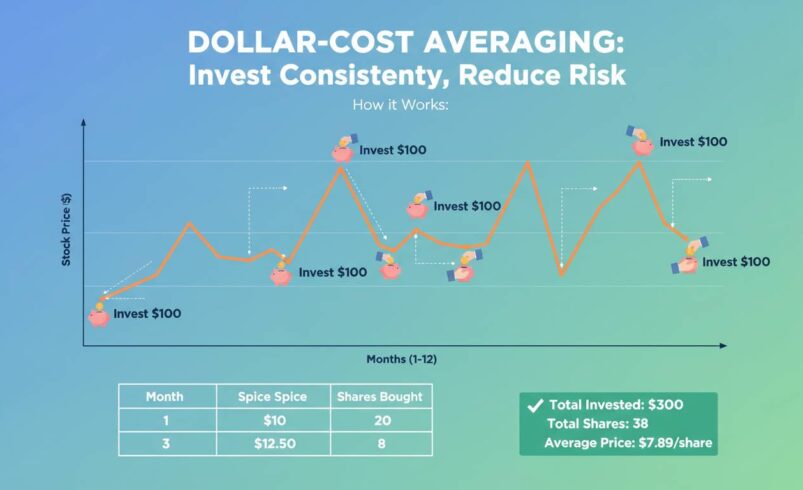
Dollar cost averaging is an investment strategy where you invest a fixed dollar amount at regular intervals—typically monthly or quarterly—regardless of market conditions, share prices, or economic headlines. Instead of trying to time the market by buying when prices seem low and avoiding when they seem high, you commit to a consistent schedule. When prices drop, your fixed contribution buys more shares. When prices rise, you buy fewer shares. Over time, this mathematical smoothing effect reduces the average cost per share across your entire investment period.
The strategy gained widespread recognition largely through its promotion by major brokerage firms and the Securities and Exchange Commission’s investor education arm. Vanguard founder John Bogle championed consistent investing as a core principle for individual investors, arguing that most people lack the expertise—or the emotional discipline—to time market movements successfully.
Here’s what makes DCA genuinely useful: it removes two of the biggest obstacles to successful investing—emotional decision-making and the paralysis that comes from trying to predict an unpredictable market. When you commit to investing $500 every month on the 15th, you remove the question of “should I invest now?” from your decision-making process entirely. That mechanical consistency is where most of the actual benefit comes from, and it’s something many explanations fail to emphasize adequately.
How dollar cost averaging reduces risk
The risk reduction argument for dollar cost averaging rests on a straightforward mathematical principle: volatility works both directions, and consistent buying smooths out the peaks and valleys over time. But understanding exactly how this works requires looking at the mechanism more carefully.
When you invest a lump sum at a single point in time, your entire return depends on what happens from that exact moment forward. If you invest right before a market downturn, you face years of recovery before seeing gains. If you invest just before a rally, you capture the upside immediately. There’s no skill involved in this—it’s pure timing luck.
Dollar cost averaging breaks this timing dependency by spreading your exposure across multiple points in time. Consider a simplified scenario: you commit to investing $1,000 monthly for six months in a fund that starts at $100 per share, drops to $50, then recovers to $100. With lump sum investing at the start, you buy 10 shares and end up with exactly what you started with—a 0% return after six months of volatility.
Using dollar cost averaging, your $1,000 monthly buys more shares when prices are low. At $100/share, you get 10 shares. At $50/share, you get 20 shares. When the price recovers to $100, you’ve accumulated 60 shares total, worth $6,000 on a $6,000 investment. You’ve earned a return simply by buying more when prices were depressed.
The risk reduction comes from this asymmetry: you automatically buy more shares when they’re cheap and fewer when they’re expensive. This doesn’t eliminate market risk—it simply reduces the risk of making one catastrophically bad timing decision. The market could continue falling for years, and DCA would continue buying at increasingly lower prices, which actually magnifies your eventual gains when recovery comes.
There’s a genuine limitation here that many advocates overlook: dollar cost averaging typically underperforms lump sum investing in bull markets. When markets trend consistently upward—as they did from 2010 to 2020 with only minor corrections—putting money to work immediately captures more gains than spreading it out. The risk reduction comes with an opportunity cost. Acknowledging this trade-off honestly is essential for anyone considering the strategy.
A real dollar cost averaging example
Numbers tell the story more clearly than explanations. Let’s walk through a concrete example that demonstrates how dollar cost averaging performs across different market conditions.
Imagine Sarah decides to invest $10,000 in an index fund tracking the S&P 500. She has two options: invest the full $10,000 immediately (lump sum) or invest $1,000 per month for ten months (dollar cost averaging).
Scenario A: volatile sideways market
In this scenario, the index fund experiences significant swings but ends at the same price where it started:
- Month 1: $100 per share
- Month 2: $80 per share (Sarah buys $1,000 ÷ $80 = 12.5 shares)
- Month 3: $60 per share (Sarah buys $1,000 ÷ $60 = 16.67 shares)
- Month 4: $80 per share
- Month 5: $100 per share
- Month 6: $120 per share
- Month 7: $100 per share
- Month 8: $80 per share
- Month 9: $100 per share
- Month 10: $100 per share
Using dollar cost averaging, Sarah accumulates approximately 108.3 shares over ten months. At the final price of $100, her investment is worth $10,830—a gain of 8.3%.
The lump sum investor bought 100 shares at $100 and ends with exactly $10,000—a 0% return. The dollar cost averaging approach wins decisively in this volatile environment because more shares were accumulated at lower prices.
Scenario B: strong bull market
Now consider what happens when markets rise consistently:
- Month 1: $100 per share
- Month 2: $105 per share
- Month 3: $110 per share
- Month 4: $116 per share
- Month 5: $122 per share
- Month 6: $128 per share
- Month 7: $134 per share
- Month 8: $141 per share
- Month 9: $148 per share
- Month 10: $155 per share
Sarah’s $1,000 monthly purchases fewer shares as prices rise: approximately 71.6 shares total. At $155 per share, her investment is worth $11,098—a gain of 11%.
The lump sum investor bought 100 shares at $100. At $155 per share, that’s worth $15,500—a 55% gain. The DCA approach still made money, but dramatically underperformed lump sum investing.
These examples illustrate the core dynamic: dollar cost averaging shines in volatile or declining markets, while lump sum investing captures maximum gains in sustained bull markets. Neither strategy is universally superior—the right choice depends on your confidence about future market direction and your personal tolerance for risk.
Dollar cost averaging vs. lump sum investing
The comparison between DCA and lump sum investing isn’t simply a matter of which is “better”—it’s about understanding when each approach makes sense and what trade-offs you’re accepting.
When lump sum investing makes sense
If you have a significant amount of capital available and can tolerate short-term volatility, evidence generally favors putting money to work immediately. Historical analysis by major financial research firms including Vanguard and Fidelity has consistently shown that lump sum investing outperforms DCA approximately two-thirds of the time over extended periods. The logic is straightforward: markets trend upward over time, so earlier investment captures more of that growth.
Lump sum investing works best when you’re confident about market fundamentals, when you’ve recently received a large windfall (inheritance, sale of property, retirement payout), or when emotional discipline isn’t a significant concern for you.
When dollar cost averaging makes sense
DCA becomes advantageous when you’re uncertain about market conditions, when you lack the emotional ability to watch a large investment fluctuate wildly in its early months, or when you’re building wealth gradually through regular income. The psychological benefit of avoiding “I just invested everything and now the market dropped” regret is real, even if it comes with an expected cost in bull markets.
Many investors find DCA particularly valuable during uncertain economic periods. The 2020 pandemic, for example, caused markets to crash 34% in just over a month before recovering to new highs by August. An investor using DCA during that period would have bought heavily during the March lows—a fortunate accident of commitment rather than skill.
There’s also a practical consideration: not everyone has a large lump sum available. If you’re investing from a salary, DCA isn’t a strategy choice—it’s simply how salary-based investing works. You invest what you can, when you can. The question becomes whether to accelerate contributions when you have extra cash or maintain your regular schedule.
Common misconceptions about dollar cost averaging
Several persistent myths surround dollar cost averaging that deserve direct examination.
Myth 1: DCA eliminates all risk. This is simply false. DCA reduces the risk of poor timing but doesn’t protect you from a prolonged bear market. If you began dollar cost averaging in 2000 during the dot-com crash or in 2007 before the financial crisis, you would have experienced years of declining portfolio values before seeing meaningful recovery. The strategy smooths volatility; it doesn’t eliminate loss potential.
Myth 2: You should always DCA into every investment. Choosing what to invest in matters more than how you invest. Dollar cost averaging into a poorly performing asset or an expensive investment product will still result in poor outcomes. The strategy assumes you’re investing in something with positive expected returns—which means your asset selection and fee awareness remain essential.
Myth 3: DCA requires perfect consistency forever. The practical reality is that life changes. Jobs are lost, emergencies arise, income fluctuates. The core principle is maintaining consistency when you can, not achieving robotic perfection. Many successful investors use a “core + satellite” approach: consistently DCA into broad index funds while maintaining flexibility to make tactical adjustments when opportunities arise.
How to implement dollar cost averaging effectively
Successful DCA implementation requires more than simply setting up automatic transfers—it demands attention to several practical details that determine whether the strategy achieves its intended purpose.
Choose low-cost index funds or ETFs. Transaction costs and expense ratios eat into returns over time. A fund with a 0.03% expense ratio will save you thousands compared to a 0.75% fund over a decades-long investment horizon. The specific investment vehicle matters less than keeping costs minimal. Vanguard, Fidelity, and Schwab all offer low-cost index funds that work well for DCA strategies.
Set up automatic transfers on payday. The most effective DCA implementation removes decision-making from the process entirely. If you get paid biweekly, set up transfers that occur the day after each paycheck arrives. This “pay yourself first” approach treats investing like any other fixed expense rather than optional discretionary spending.
Stick to the schedule regardless of news. The entire point of DCA is avoiding the temptation to time markets based on headlines. When the news feels terrifying—recessions, crashes, geopolitical crises—you’ll be tempted to stop contributing. Those moments are precisely when DCA provides its greatest benefit by buying shares at depressed prices. The ability to maintain contributions during market stress is what separates successful DCA practitioners from those who abandon the strategy at the worst possible moments.
Consider your tax situation. If you’re investing in taxable accounts, be aware that regular contributions may create frequent small tax events. For many investors, using tax-advantaged accounts (401(k), IRA, Roth IRA) for DCA makes the most sense. The specific details depend on your income, tax bracket, and whether you qualify for various retirement account contributions.
Frequently asked questions about dollar cost averaging
How often should I contribute to a DCA strategy?
Monthly contributions are the most common and practical frequency for most investors. Quarterly works equally well mathematically, but the longer interval between contributions can make it easier to miss your intended schedule. Weekly contributions add administrative complexity without meaningful mathematical advantage. The best frequency is whatever you’re most likely to maintain consistently.
Does dollar cost averaging work in a Roth IRA?
Yes, DCA works perfectly well inside a Roth IRA or any other account type. The strategy itself is simply a timing approach for when you put money to work—it has no relationship to account structure. Whether you’re using a Roth IRA, traditional IRA, 401(k), or taxable brokerage account, the mechanics and mathematical properties of DCA remain identical.
What happens if I start DCA and the market drops 50%?
You continue contributing according to your schedule. This is precisely when DCA demonstrates its value: when markets fall, your fixed contributions buy more shares at lower prices. When (not if) markets eventually recover, you’ll own more shares than you would have if you’d stopped contributing during the decline. The key requirement is emotional discipline to maintain contributions when your portfolio is shrinking—which is genuinely difficult but essential for the strategy to work.
Is dollar cost averaging better than timing the market?
For most individual investors, yes. Market timing requires making two correct decisions: knowing when to get out and knowing when to get back in. Research consistently shows that even professional investors struggle to time markets successfully over extended periods. Dollar cost averaging accepts that perfect market timing is impossible for ordinary investors and instead focuses on capturing average market returns with reduced timing risk.
The bottom line
Dollar cost averaging isn’t a magic formula for investment success—it’s a disciplined approach that trades some potential upside for reduced timing risk. It works best when you understand exactly what you’re getting: a method that almost certainly underperforms lump sum investing in strong bull markets but provides meaningful protection against the worst-case scenario of investing everything right before a crash.
The strategy’s real value isn’t mathematical—it’s psychological. For investors who struggle with market volatility, who feel compelled to “do something” when markets move, or who lack confidence in their ability to time entries correctly, DCA provides a structured framework that removes emotional decision-making from the equation.
Whether that’s worth the expected underperformance depends entirely on your personal circumstances, risk tolerance, and emotional relationship with money. If you can sleep soundly knowing your lump sum might drop 30% in the first year, investing immediately likely makes more sense. If that scenario would trigger panic selling or endless anxiety, the psychological benefits of DCA may justify the mathematical trade-off.
What matters most is starting somewhere. The worst investment strategy is the one you abandon when markets get difficult. For many people, dollar cost averaging provides the structure and discipline needed to maintain consistent investing through decades of market fluctuations—which, ultimately, is what builds long-term wealth.